Apache Log4j is a Java-based logging utility library that is part of the Apache Logging Services, a project of the Apache Software Foundation. Since this software is prolific in internet-connected devices, from IoT products like TVs, cameras, and portable devices to servers running major vendor’s cloud operations, a vulnerability in Log4j, can be described as “catastrophic” and “nightmarish”, since not only resolution can be complex, but also because the affected version of Java has existed since 2013.

Cybersecurity experts from the FBI, CISA, and the NSA continue to warn, that since the vulnerabilities became public in early Dec. ’21, there has been increased activity by nefarious state actors, and ransomware groups actively scanning networks to potentially exploit the vulnerability in Log4Shell (Apache’s Log4j software library, versions 2.0-beta9 to 2.14.1). This remote code execution (RCE) vulnerability can be used to deploy Cobalt Strike beacons, crypto miners, and botnet malware. This became evident even in the Java edition of Minecraft, Microsoft’s popular video game when players could compromise other players’ systems by sending malicious code through chat messages.  The list of affected companies and software continues to grow. However, federal agencies faced a Dec. 24. 2021 deadline to remediate the vulnerability even though CISA has not encountered any confirmed breaches of Federal agencies via the vulnerability.

For Java 8 users Apache has released Log4j 2.17.0 that includes patches for the RCE vulnerability and denial-of-service vulnerabilities.  For Java7 users Log4j is at 2.12.2, to address the RCE vulnerability

In response to this threat, organizations should, at a minimum, take the following steps:

  • Immediately identify any systems vulnerable to a Log4Shell attack, by using the new CISA scanner utility mirroring a similar tool released by the CERT Coordination Center (CERT/CC).
  • Identify any systems using Log4J Java library and immediately ensure it is not being used in any production systems and patch with updated security corrections.
  • Identify internet-facing applications that allow data inputs and use log4J; they are vulnerable to attack. Assume compromise
  • Use logs to identify unusual traffic patterns e.g., JNDI LDAP/RMI outbound traffic, DMZ systems initiating outbound connections
  • Update Apache servers with the latest updates for Apache HTTP Server
  • Monitor the Apache Log4j Security Vulnerabilities webpage for mitigation guidance
  • Seek help from a trusted vendor/partner

Read the Department of Homeland Security’s Cybersecurity and Infrastructure Security Agency (CISA)’s guidance on the Log4j vulnerability here and has added this vulnerability to its Known Exploited Vulnerabilities Catalog | CISA –  a list of vulnerabilities organized by severity.

In a connected world, vulnerabilities are inevitable.  Therefore, all organizations would do well to follow CISA guidelines and take proactive steps to reduce risks and breach impact.
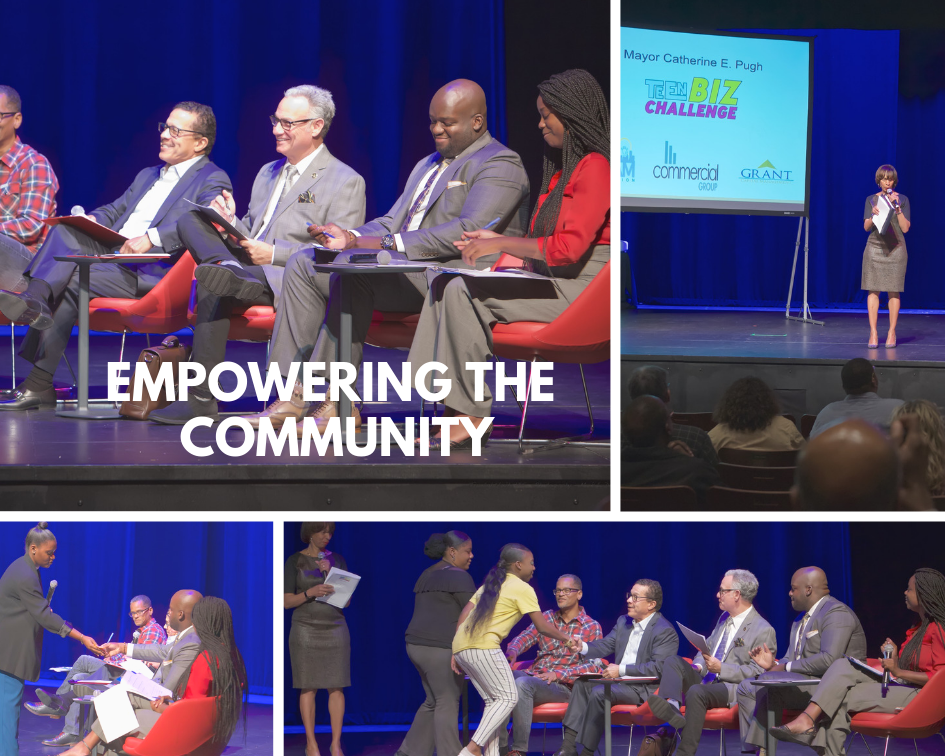

As I sat in the judge’s panel, I could feel the electric excitement in the air. 11 youths, representing nine different businesses, were pitching their innovative ideas in the Teen Biz Challenge, held by the Office of the Mayor, Catherine E. Pugh, in Baltimore. The competition was inspired by the popular “Shark Tank” television series and the teens were competing for up to $6,500 in startup funds for their “big ideas”.

The teens came prepared, armed with creativity, talent and cool ideas for businesses, from the OmegaBrush, an innovative dental hygiene product presented by Mahmoud Shelby (18 years old), to Miracle Box, a subscription service for healthy food delivery presented by Sa’Niya Sherman (16 years old). Kamri Moses (14 years old) presented a mouthwatering array of smoothies and assorted beverages for his KR Smoothies business.

The pitch that received the highest level of funding came from a recent high school graduate and current freshman student at Stevenson University, Ciera Smith (18 years old). Ciera’s business, Naturally Me is a monthly subscription service for feminine hygiene products. Ciera Smith received $6,500 in the accelerator program and each business that pitched received at least $1,000 in funding.

All the teens that pitched were graduates of the 2018 Y.E.S. (Youth Entrepreneurship Startup) Summer Program. WhirlWind was a Gold Sponsor this year, and as I sat there in the judge’s panel, I thought the impressive presentations were a testament to the important work facilitated by the  D.R.E.A.M. (Developing Resources to Empower All Minds) Foundation.

At WhirlWind, we fleshed out what empowerment means to us and came to the core of helping people to understand and fulfill their potential. Showing up for the teens and serving as judge and mentor gave me a front seat view into the next generation’s incredible potential. It is also important for us to engage local talent and businesses, for they translate into a stronger economy and contribute to thriving communities. And for this, I am excited to do the work I do.<?p>

What comes to mind when you think of “helping people to understand and fulfill their potential?” What inspires you when it comes to empowering yourself and others?

Related Press Release: WhirlWind Technologies CEO as a Panel Judge for the Teen Biz Challenge

For our latest philanthropy project at the end of the year, we decided to include the entire company. This is a time of year that calls for gratitude, reflection and generosity to those less fortunate than us. We set up collection boxes at different locations, and gave our WhirlWind techies an option to donate toys for the Toys for Tots program. We collected and donated over 150 toys this year!

Toys for Tots is a program run by the US Marine Corps Reserve that distributes toys to children whose parents cannot afford to buy them gifts for Christmas. “When you donate to Marine Toys for Tots you are helping to bring the joy of Christmas and send a message of hope to America’s less fortunate children.” is their tagline and their impact is felt in homes all over America. Founded in 1947, the Toys for Tots program has delivered 548 million toys, supporting 251 million children to date.

And the difference is felt. Cindy, a gift recipient from California, shared a heart moving story of her memories.  “Toys for Tots was the only reason I received a gift for Christmas each year as a child. I remember my dad waiting in line the whole day in order for me and my siblings to have something to open on Christmas. I have such great memories thanks to this program. Thank you to everyone who donates to this great cause.”

The impact of working collectively to help others can not be overstated. As reiterated by a community organizer in Georgia, “…The Toys for Tots Program is a blessing for the community we serve. We have had families tell us that they would not have had anything under the tree if it was not for this program. There is so much work to do, but as long as we take a piece and someone else does the same, eventually we can reach as many needs as possible.”

Thank you to all the WhirlWind techies that contributed! With this project we want to emphasize we can all embrace WhirlWind’s purpose to empower others. Our core values include #Have the mindset of an entrepreneur (Empower) and #Take the Initiative (Commitment) and together we will work to empower as many people as possible!

The best gifts are sometimes the unexpected ones! What is your best (or most unexpected) gift to date?

“What is your favorite humanitarian effort?” I posed this question during our Monthly Leadership & Management meeting in August. I wanted to get a sense of what was important to our leaders at WhirlWind Technologies, and to vote on our next philanthropy project. The answers ranged from mental health advocacy to global relief,  but what seemed to resonate the most is the topic of youth and education and helping under served communities.

The timing of the discussion coincided with the beginning of the 2018 school year. By the end of the discussion, we voted to donate school supplies to children in need. We picked Oaklands Elementary School, in Laurel Maryland, because it is a Title I school. Title I is part of the Elementary and Secondary Education Act of 1965 (ESEA)  which supports schools with large concentrations of low-income students in meeting its students’ educational goals.

Eight students in total were selected, a boy and a girl from 2nd grade, 3rd grade, 4th grade and 5th grade respectively. The classrooms we chose were also being taught by new teachers to the school, and we hoped equipping the students in their classrooms would also ease the teacher’s experience.

Being a mom with a school age child, this cause is close to my heart. I took my son to go shopping for supplies at Walmart. We printed the Prince George’s county school system list of suggested school supplies and spent the day selecting the book bags and supplies, while discussing our civic responsibility and the importance of lending a hand to people who are struggling in our community.

A little goes a long way too, as we heard back from Candice Nicholson, the 2nd grade teacher “Since I work at a Title 1 school, kids always need supplies that their parents can’t afford. Well, WhirlWind saved the day, when I was able to give supplies to not one, but two students.”  

Meanwhile, Taylor Mcleod, the 3rd grade teacher spoke from a new teacher’s perspective, “This is my first year of teaching. I had no idea how hard teaching is. I didn’t know that all parents don’t buy their kids school supplies. That made me sad because I can’t afford school supplies for all the students in my class. Thank you WhirlWind, for taking some of that stress away from this first year teacher.”

“Thank you, WhirlWind, for supporting the needs of our students,”  Jewel Preston, the Principal of the school, added. “ Companies like yours make my job easier.”

I am proud to be part of a company that takes its social responsibility seriously. Our vision includes empowering our community and future leaders. Our purpose is to help people to understand and fulfill their potential, and sometimes that involves removing barriers so they can succeed. In our latest project, we hope giving students the tools they need will free them to focus on the important task at hand: learning.

What’s your favorite philanthropy effort? What does giving mean to you?

I am passionate about empowerment, which is emerging as one of WhirlWind’s foremost core values. We are exploring the idea of empowering all of our stakeholders, by listening to their needs and identifying their opportunities and challenges.

So  I was excited when I got a call from a local Prince George’s County nonprofit called the D.R.E.A.M. (Developing Resources to Empower All Minds) Foundation to sponsor the 2018  Y.E.S. (Youth Entrepreneurship Startup) Program. The Y.E.S program is a five-week, all expenses paid summer camp for Baltimore City high school students, aimed at entrepreneurship  and financial literacy. WhirlWind became a Gold sponsor for the event, allowing the students to participate at no cost, including lunches, field trips and lectures from other entrepreneurs.

This summer, the Y.E.S. program hosted a total of 26 high school students. Y.E.S. participants learned key concepts of running and operating a business, from creating an idea, to competitor analysis, market trends, value proposition and scalability. The students met with 21 entrepreneurs from diverse backgrounds, who shared their success stories and struggles. The students also visited National Museum of African American History and Culture (NMAAHC) to study black inventors and pioneers.

The graduates of the Y.E.S. Summer program in 2018 will participate in the Teen Biz Challenge held by the Office of the Mayor, Catherine E. Pugh, in Baltimore. The teenagers will present their ideas to a panel of judges, including myself. They will pitch their businesses for a final round of up to $5,000 in startup funds.

I connected with a lot of bright and promising students with lofty ideas, and that was really inspiring. We are in the process of crafting our Big Hairy Audacious Goal (BHAG) to empower 10,000 people in 10 years, working on it through one relationship at a time. Sponsoring the Y.E.S. program  is a step in the right direction. I look forward to more.

What does empowerment mean to you? In what ways can you demonstrate the core value of empowerment in your own roles (at WhirlWind and outside)?

Related Press Release: WhirlWind Technologies, LLC Headlines the Y.E.S. Program as a Gold Level Sponsor

“The three most dreaded words in the English language are ‘negative cash flow’.” -David Tang

The last section in the “Scaling up: How a Few Companies Make it…and the Rest Don’t” by Verne Harnish, detonates typical assumptions about the role of cash in a business. Harnish  notes that “Growth sucks cash” and he illustrates a company that was literally “growing broke.”

What was surprising about this section is that Harnish suggests that regular Key Performance Indicators (KPIs) for the financial health of a company are misleading. For example, companies often first tout   “Revenue,” which he terms “Revenue Vanity”. Another common KPI is “Profitability”, but Harnish asks “What is more important, profit or cash?” For a growing business, the resolute answer is “Cash.” A huge influx of cash allows the likes of Amazon to thrive,  even while breaking even or posting losses.

Companies are usually Profit-focused, but considering only the Revenue minus Expenses will provide a skewed view of the numbers. The saying is “Revenue is vanity, profit is sanity and cash flow is king.” The numbers can be manipulated to show “profit”, but only cash and debt balances are facts. Cash and debt balances, incidentally, are what banks look at to evaluate a company’s performance.

So how do you increase cash flow? Our plan is to implement Harnish’s suggestions:

  • Shorten cycle time – How fast does a dollar invested in the business (from finding an opportunity all the way to revenue) come back to the company? This is a KPI Harnish suggests called the “Cash Conversion Cycle.”  To this point, Every WhirlWind Techie has a direct impact on our cash flow. When a techie fails to submit his/her timesheet on time, that delays our invoicing and increases our Cash Conversion Cycle. When Project Managers don’t submit their monthly reports on time, that also delays our invoicing.
  • Eliminate mistakes – Make sure your hours are entered in the right bucket, invoices are submitted on time in the right format, and within the correct timeframe.
  • Change the business model – This entails changing how we charge clients to provide services or products. The simplest recommendation Harnish gives is simply asking clients to pay earlier in the cycle. We have other plans in the works to commoditize our services. Stay tuned to hear more.

Another initiative we want to roll out to all our Techies is Financial Literacy, spanning the personal and business aspects of Finance and empowering everyone in the company to contribute to the cash flow.

Do you have any ideas on increasing our cash flow? What can we start, stop, or continue doing to increase our cash flow? Your voice is important to us!

Why outsource Technical Communication? To most of our clients, outsourcing their Network Engineering services, Data Centers, or Help Desk services makes financial sense. They can evaluate their Information Technology (IT) needs, perform a cost/benefit analysis, and contracting out the services can be traced to a specific cost saving.

Technical Communication, on the other hand, is seen as more of an overhead expense than a revenue-generating or cost-saving measure. Why not let the vendor who is offering the Network Engineering services take care of the documentation? Why not create the necessary documentation in-house? Why not let the technical people in charge of the systems write their own documents? This blog explores the pitfalls that come with this reasoning, and next week, in Part II we will provide tips on finding the right Technical Communication-as-a-Service team.
Industry Challenge
The problem, poorly documented systems, stems from many sources. Typically:

  • Engineers and developers are too busy working on the systems to document
  • Some engineers and developers lack writing skills and avoid the task
  • Many engineers and developers hate writing or view documentation as a “waste of time”
  • Documentation is viewed as an “extra” task to be accomplished rather than an important part of the development lifecycle
  • Documents are viewed as a non-revenue generating activity and tend to be low on the priority list

In most cases, systems operate without proper documentation until some exigency brings the gaps to light:

  • A senior engineer or developer suddenly leaves, and there’s no knowledge transfer and nothing documented to help the person coming on board
  • Reviews or accreditation cycle due dates create external pressure for documents to be in place
  • A poorly documented system breaks down, and issues with systems that are poorly documented are harder to diagnose
  • A poorly documented system needs upgrades, and It becomes difficult to keep track of what’s the baseline versus what’s being added, creating layered and opaque systems that are hard to navigate

Bottom Line Consequences

At first glance it may seem like documentation is an unnecessary overhead expense, but poorly documented systems actually cost money. Here are some ways you are increasing your cost in developing and maintaining poorly documented systems:

  • Scope creep: Developing systems without proper documentation makes it harder to keep track of the scope and know when the system is considered “Done.”
  • Cost of maintenance: Senior Engineers spend more time diagnosing and fixing problems that could be delegated if the system is properly documented.
  • Compliance: The government mandates standards on documentation of system to qualify for continued accreditation. Non-compliant systems are costly. They increase pressure on the IT teams, who should be focusing on getting other aspects of the system ready for accreditation. Outsourcing documentation at the last minute will actually cost more.
  • Perception of quality of system: Even outside of the government sphere where a minimum standard of documentation is not enforced, users perceive poorly documented systems to be inferior in quality and that perception affects the price they are willing to pay for it.
  • Increasing burden on IT Team: End users rely on the IT Team for support when documentation is not readily available.  IT systems with excellent documentation create a “self-service” platform for end users to access the information they need reducing reliance on the IT Team for every minor request.

Clearly, documentation is both a necessary component to your bottom line, and one that is often difficult to produce in-house. It may make perfect sense to leverage your IT team’s skills, allowing them to turn documentation over to the experts so they can focus on what they do best. When freed up to focus on the systems themselves, engineers can attack the actual never ending list of work they have to do including development, upgrades, maintenance, and more.  But how to choose the right team of experts?

In Part II, we’ll examine the criteria to use in selecting the right Technical Communication-as-a-Service team.

“Imagine if all members of your team could independently and confidently wing it in their roles in a way that you knew would be consistent with the company culture and objectives.” This quote on page 176 of “Scaling up: How a Few Companies Make it…and the Rest Don’t” by Verne Harnish is at the heart of the Execution section and was literally music to my ears.

In the book, the analogy Harnish uses is the synchronicity of jazz, with its mix of improvisation and rhythm. It brought to mind my favorite Jazz band, The Robert Glasper Experiment and how they defy all genre norms while bringing a fresh brilliant spin to their compositions. When we identify specific tasks and habits to  set the stage for flawless execution, we free Techies to improvise and “riff” through their workday, minimizing the need to check in for direction. My goal is to use these principles to free up 80% of our leadership team’s time, and to shift their attention from day-to-day management to pursuing new clients and markets.

Do a Reality Check: The section opened with the “Rockefeller Habits Checklist” which painstakingly covers different functional areas of an organization. The checklist gave us a taste of what the full scale Team Assessment kit will provide. We are exploring the option of assessing our Executive Team to see how healthy and aligned we are by December of this year.

”Keep the main thing the main thing:” Harnish quotes the late Stephen Covey in opening the section.  The number 1 priority for us, is to literally determine what our most important and measurable priority (Critical Number) within a 90 day to one-year focus would be. This would be the main goal that will anchor all of our execution planning and activities.

Collect Solid Data: One main execution activity related to the Critical Number is Data. After all, there’s no way to ascertain any measurable achievement without solid data. We are going to start with a really quick and easy survey to our clients, employees and shareholders, asking three simple questions:

  • What should we start doing?
  • What should we stop doing?
  • What should we keep doing?

The most important part of the survey will be a feedback loop, where we will update the employee on whether we implemented their suggestion or not (and why not).

Facilitate Ongoing Communication: When meetings are centered on the key Critical Numbers and routinely scheduled with a purposeful agenda, they “bring focus, alignment, provide an opportunity to solve problems more quickly and ultimately save time.”

One of my goals is to work closely with my Executive Assistant and finalize my  2018 calendar before the next year begins.  We also plan to reassess the purpose of all our recurring meetings and  group our weekly meetings together (so that all 1:1’s are scheduled on the same day, for example). And as part of bringing our techies together, we discussed implementing a peer coaching system at WhirlWind.

The path is laid for us to take on our Big Hairy Audacious Goal (BHAG) one priority at a time, one celebration at a time, one meeting at a time, one challenge at a time, and ultimately one single step at a time. Or to put it in Jazz terms, we will perfect one musical note at a time, one composition at a time, and empower our techies to improvise and play in concerted harmony.

“This [game] is chess, it ain’t checkers!” The classic quote from the movie Training Day came to mind when I was reading the section on Strategy in “Scaling up: How a Few Companies Make it…and the Rest Don’t” by Verne. It was by far my favorite part of the book.

Sometimes people tend to think running a business is as straightforward as checkers. You make move X, Y, and  it leads you directly to your expected outcome Z. In business this usually translates to the simplistic logic of, “If I produce more, I will increase my revenue.” This is only partially true. In my experience, running a business mirrors the complexity of chess. Sometimes, you have to step back and think three or more moves ahead. Sometimes, it’s counter intuitive, you must sacrifice a pawn for the queen down the road. Sometimes, you have to reverse engineer your moves and it may not make any sense to a lay observer. And most of the times, you have to reevaluate your strategy, as chess is a dynamic game and unexpected moves from your opponent could result in unforeseen obstacles.

The section on Strategy spoke directly to me as a leader, and I was heartened that we have intuitively adopted some of the ideas Verne introduces. The flip side of that is I am enjoying the challenge to work with the other concepts we haven’t yet  defined. I’m particularly excited for the chance to step back and reassess, redefine, and articulate our overall strategy.

As in all the sections, Verne provides specific tools and a framework for our discussions. In Strategy, he speaks to the athlete in me by discussing the importance of “core” strength. A company’s version of lower back and oblique muscles and a six pack of abs is its:

  • Core Values
  • Core Purpose
  • Core Competencies

Core Values

Although we have defined core values, I found myself looking forward to creating a space where we can explore our original core values again and test whether the same ones will stick or new ones will emerge.

One key takeaway from the book is that core values define the company’s culture, and provide a final “should/shouldn’t” test for all the behaviors and decisions by everyone in the firm. Core values also express a company’s personality. Our company is relatively young and fast growing, so this is an opportune time to step back and discern our core values.

Core Purpose

The core purpose, according to Verne, expresses the “heart” of a company and answers the “Why?” A powerful purpose tends to revolve around a single word or idea (e.g., Happiness = Disney, and  Innovation = 3M).

I have some ideas around our core purpose revolving around how we do technology differently to positively affect people’s lives, whether it is our employees, clients and shareholders, and being a remote/Distributed first culture that allows us to work in atypical and agile ways.

One thing that burns me up as a CEO, is when I find us doing something just to be typical. This process has me reflecting on how we can infuse the word different in everything we do and making it concrete. I look forward to applying the 3 “Why?” questions, to our purpose to drill down into our core purpose.

Core Competencies

According to Verne, a core competency has 3 attributes:

  • It is not easy for competitors to imitate
  • It can be reused widely for many products and markets
  • It can contribute to the benefits the end customer experiences and the value of the product or services to customers

What’s important about defining and articulating our strategy lies in understanding what we don’t do and in this way coming to a mature space where we may decide we don’t want to pursue a certain client or line of business because that’s not in line with our strategy.

Verne makes a note in the book that if defining the strategy were an easy process, every company would have a killer strategy. This process is actually harder for CEOs who think they have all the answers, since it is necessarily a messy and creative process. This really spoke to me, and I realized that much of my journey so far has been intuitive and I am willing to trust this process.

He then goes through a specific framework, by far my favorite tool, called the 7 strata of strategy to help the strategic thinking team to create and maintain a competition-crushing, differentiated approach to a specific market.

It will be hard work to wrestle with these questions and articulate our own vision summary, as these are atypical questions for growing businesses to face. More importantly, this work can not be done behind closed doors by a handful of executives. It will require a sustained engagement with you: our frontline employees, our clients, and our managers. The payoff will be huge as we all get on the same page and create an unstoppable momentum with the WhirlWind we create. And like a good game of chess, we may not have all the answers at the beginning of the game, or even the middle. This is going to be one of those drawn out, long term games and we are “in it to win it”.

People inspired me to found WhirlWind Technologies, including  mentors, supervisors, and clients. I wanted to do technology differently by forging long term relationships with clients and customizing technology to their needs, rather than selling them solutions for the sake of increasing revenue. I  also wanted to  provide a platform for other talented IT professionals, offering them the tools to grow and succeed. My vision was to create an environment where skills, dedication and growth are championed and a safe space where no one would be overlooked or stymied due to bias. So on that auspicious day, January 1st  2009, I founded WhirlWind Technologies, LLC  in my old childhood bedroom at my parent’s house.

We have come a long way since then, and reading “The People” section in “Scaling up: How a Few Companies Make it…and the Rest Don’t” was timely for us. Verne poses a couple of questions as a call for reflection:

  1. Are you happy?
  2. Would you enthusiastically rehire everyone knowing what you know today?

The People section of the book  was broken into three chapters:

  • The Leaders: How do you define senior leadership accountabilities, Key Performance Indicators (KPIs), and outcomes?
  • The Team: How do you attract and retain A players, and use Topgrading interviews to recruit “strange” people to fit a “strange” culture?
  • The Managers: How do you turn managers into coaches who motivate rather than dehassle their teams?

In sharing this book internally as a map, our aim is to give WhirlWind Techies the tools to grow with us as we scale, rather than prescribing what they need to do. Although it is not required reading for everyone, I recommend you check it out to gain insight into our direction.

Leaders:

One definition that popped out was how to recognize leaders in the company. Verne says, once you’ve found people that fit your culture,  leaders pass two tests :

  1. They don’t need to be managed
  2. They regularly wow the team with their insight and output

I would like to challenge every WhirlWind Techie to apply these two tests to yourself and ask: Am I a leader? And if not, what would it take for me to step up my game?

One point resonated with me personally, is when Verne notes that the CEO’s greatest strength can be the company’s greatest weakness, especially when everyone depends on the CEO for what they bring to the table. In my case, my expertise is in Network Infrastructure, and I have to make sure I am not the achilles heel for the company by recruiting and empowering other Network Infrastructure Techies to serve as Subject Matter Experts.

There’s also a fine distinction between Responsibility, Accountability and Authority. Many people can be responsible for different facets of a project, but only one will be held accountable (usually the team lead or functional area manager). But having accountability for a project (or even a task/process) does not mean you have full authority. The person with with final decision-making power is the one authorized. For instance, a CFO may be accountable for the cash, but the CEO still maintains the authority over the cash.

The Team:

We discussed Topgrading Interviews at length, since this methodology requires an upfront investment of 3-5 hours for each candidate (on interviewing alone)! Yet, we concluded that our goal is to select the best hire, and in order to do so, we have to put in the time. Beyond that, hiring the wrong person would cost the company a lot more in the long run than the initial time investment to verify the fit.

Verne provides a number of tools for managing and coaching different aspects of People, their KPI’s  and Outcomes associated with them. We have already allocated time in our next Strategy Meeting to work through the full details.

The Managers:

Verne has specific advice for managers (or coaches as he prefers to call them). Some of the pointers were more intuitive such as helping people to play to their strengths, setting clear expectations and giving recognition. Others gave us pause, for instance in preventing “dehassling” and “demotivating” he discusses firing a client who may be unreasonable and mistreat your employees. Or another example is not to demotivate “A” players by having them work with “B” and “C” players who suck their energy and slow them down. The best managers, according to Verne, are those who lead, coach, and actively remove obstacles from each of their team member’s path to ensure their success.

So, going back to the questions that Verne posed in the very beginning:

  1. Am I happy? Unequivocally yes! My business mission is an extension of my own personal purpose which is to master my own mind and body, and furthers my own personal vision to embody personal and professional success to my family and community. I feel aligned in both my professional and personal life.
  2. Would I enthusiastically rehire everyone knowing what I know today? Yes! We finally have the right people in the right seats. I challenge each of you to get your A-game on for this WhirlWind ride.

Leicester city winning the 2016 season English Premier league champions despite a 5000:1 odds when they started the season. The top teams in the English Premier League all have one or two players that make more money than Leicester’s whole team combined.  This win demonstrates the synergy between clear roles, priorities and teamwork.  (Photo attribution: Wikipedia) (Youtube video link on the story)

Download Our resources